Mountains, Borders, and Natural Barriers in Fantasy Worldbuilding
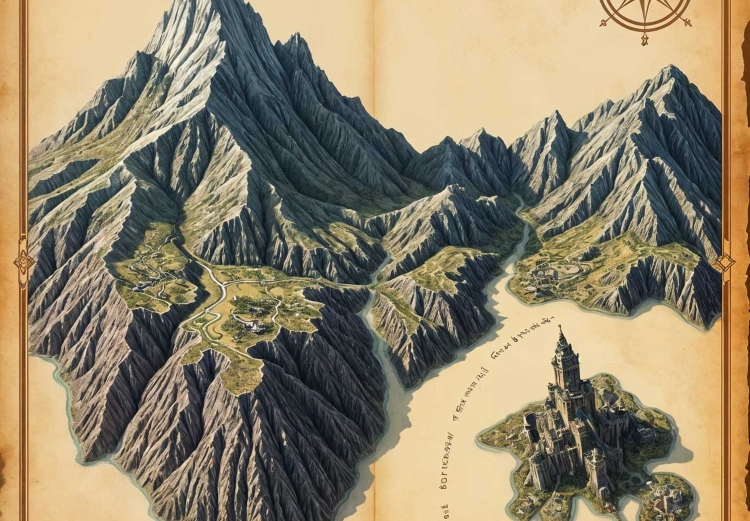
Pull out the map from almost any beloved fantasy novel — Tolkien's Middle-earth, Ursula K. Le Guin's Earthsea, Brandon Sanderson's Roshar — and you'll notice something immediately. Before you read a single word of the story, the geography is already telling you things. That jagged spine of mountains running north to south? It's not decorative. It's an argument.
Natural barriers are among the most powerful tools in a worldbuilder's kit, and they're often underestimated. We treat them as background: dramatic scenery for the heroes to traverse, an excuse for a gruelling travel sequence, a reason why the southern kingdom hasn't invaded yet. But the mountains, the rivers, the deserts, the impassable marshes — these aren't just obstacles on the map. They're the bones beneath the skin of your world.
Let's dig into what they actually do, and how to use them better.
Geography Doesn't Just Shape the Land. It Shapes the People.
Here's the first thing to sit with: people who live in different geographical conditions develop genuinely different cultures, politics, economies, and psychologies. Not because one group is superior to another — but because the land makes different demands, and people respond.
Mountain communities tend to be insular, self-sufficient, and fiercely proud of their autonomy. When you're three days' hard climb from the nearest neighbouring settlement, you develop local solutions to local problems. You don't wait for the lowland king to send help; you build your own traditions, your own justice systems, your own gods. You also tend to be deeply suspicious of outsiders — not necessarily from prejudice, but because strangers arriving over a mountain pass rarely did so by accident, and rarely meant nothing by it.
Coastal peoples are the opposite. They're outward-looking, cosmopolitan, comfortable with trade and foreigners and ambiguity, because the sea connects rather than separates. A harbour town sees the world come to it.
"The most interesting cultural borders in your world often aren't the ones on your map. They're the invisible lines where one way of living rubs up against another — and that friction is where your best stories live."
Flatlands breed large kingdoms and bureaucracy, because there's nothing stopping anyone from riding from one end to the other. River deltas breed city-states and merchant oligarchies. Steppes breed nomadic cultures that the settled kingdoms never quite manage to understand or conquer, no matter how many times they try.
None of this has to be deterministic — people are not simply products of their terrain. But if your mountain culture is indistinguishable from your coastal culture, you've left something on the table.
The Politics of Borders
Natural barriers don't create nations — but they make certain borders more legible. A mountain range that runs for a thousand miles is a border that enforces itself. The river that's navigable only in summer is a border that breathes. The desert that shifts every year is a border that lies.
This matters enormously for the political history of your world, and therefore for how your characters understand their identities.
A kingdom whose frontiers are clean mountain ranges will have a very different relationship to its own nationality than one whose borders are dotted lines across a flat plain. The first has clear answers to "who is one of us." The second has generations of contested villages, mixed marriages, dialects that bleed across, and people who genuinely don't know which side they're on when the war starts.
Three questions worth asking about every major natural barrier in your world:
- Who controls the passes? Mountain ranges are only impassable until they aren't. The passes — whoever holds them — hold enormous power. A minor kingdom sitting atop the only viable mountain crossing between two great empires might be tiny and militarily weak, and yet politically untouchable, because neither empire can afford to let the other have it. That's a fascinating position for a nation, and for a character born into it.
- What does it cost to cross? Time, money, danger, or political permission? A barrier that can be crossed freely with sufficient resources creates a very different social geography than one that requires a lord's warrant or a particular season. Think about who gets to cross, and who doesn't — that asymmetry is almost always the source of resentment.
- What lives on both sides? The thing about borders is that they're usually drawn through the middle of something. A mountain range might be the border between two kingdoms, but the people who live in its valleys may have more in common with each other than with the lowlanders on either side. That tension — official borders cutting through cultural reality — is one of the oldest sources of conflict in human history, and it works just as well in fiction.
Natural Barriers as Narrative Pressure
Here's the craft argument: natural barriers aren't just worldbuilding infrastructure. They're structural devices that shape your plot.
A barrier your characters must cross creates anticipation, cost, and consequence. The crossing itself is a transition — and good storytelling loves transitions, those liminal moments when characters are between one state and another and anything might happen.
But more than that: a barrier that cannot be crossed in time creates urgency. A barrier that should not be crossed creates forbidden desire. A barrier that was once crossable but no longer is creates loss.
Consider what the barrier is protecting, and from what.
The Mines of Moria aren't just a mountain crossing. They're a tomb, a history, a horror, and a shortcut that becomes something else entirely. The mountain forces the Fellowship to confront something they would otherwise have avoided — and that's exactly what barriers do at their best. They don't just block the easy path. They redirect characters toward the path the story actually needs them to take.
Think about your own world's major geographical features in these terms. If your heroes can go around the Thornwood, they will go around the Thornwood. If you want them to go through it, you need to make the alternatives worse. And once they're in the Thornwood, what does the Thornwood demand of them that nowhere else could?
The Map as Character
There's a wonderful habit among fantasy writers of drawing the map last — once you know your story, you draw the world that fits it. There's nothing wrong with this, but it can lead to geography that's decorative rather than functional.
The alternative is to let geography drive some of your choices. Scatter your settlements, then ask: how do these people actually know each other? What routes make sense? Where are the chokepoints? If a kingdom is trying to expand, where's the logical direction — and what stops them?
If your world has magic that can bypass natural barriers (flight, teleportation, portals), think carefully about what this does to your political and military geography. A world where armies can teleport has no defensible borders. A world where only a few powerful individuals can fly changes the social weight of altitude. The Eyrie is menacing partly because it is so hard to reach.
Magic that nullifies geography isn't wrong — but it should transform the implications of geography, not simply ignore them.
Common Mistakes (and How to Sidestep Them)
The convenient mountain range. There's a mountain range between your two kingdoms because you needed a border, and mountains feel appropriately epic. But if it's never been relevant to the plot, the economy, the history, or the culture of either kingdom — if it's only there to show up on the map — it's doing less than it could. Give it a pass that somebody controls. Give it an ancient name that both kingdoms argue about. Give it a weather pattern that shapes the agricultural calendar on both sides.
The uncrossable barrier that gets crossed in chapter two. If your geography makes something seem impossible, and then it turns out not to be very difficult at all, you've undermined your own world's rules. Either the barrier needs to be genuinely costly, or you need to be clearer earlier that it can be managed.
Uniform peoples on one side. The Northmen are all fierce and the Southerners are all decadent — and the mountains explain why they never mixed. But real populations aren't uniform even within a single valley. A mountain range that's kept two cultures separate for centuries will have left some communities that have mixed, traded, or merged. The exceptions are often more interesting than the rules.
A Final Thought: The View From the Top
There's something peculiar about mountains in fantasy — and in life. They're barriers, yes. But they're also the highest points in the landscape, the places from which you can see the furthest.
In fiction, characters who make it to high places tend to understand things. They see the scale of what they're up against, the shape of the world they've been moving through without ever fully seeing. Mountains block and mountains reveal, often at the same time.
The best natural barriers in your worldbuilding work the same way. They stop easy movement — and in stopping it, they force characters to look more carefully at where they are, what they've left behind, and what they're truly heading toward.
The geography of your world isn't just the stage. It's part of the story. Treat it like one.